

Welcome to the age of anti-aging.
How a cultural obsession with looking young is not just about aesthetics, it's about power.

Let me take you back to a hot spring day in LA—a Sunday if I recall—at a tiny woman-owned thrift shop on Glendale Blvd.
Sweat curling behind my thighs, I wondered if choosing to wear a fur-collared sweater in the LA May heat was a faux-fur-pas.
Marta (who was the owner of the thrift shop I’d stepped into in hopes my fuzzy flare would pass the dress code somewhere), complimented my outfit and said, “I dressed just like you up until my 50s”.
She told me she couldn’t wear heels anymore. Now she wears platforms. That she used to wear shorts like mine, but her legs would get looked at now, and for all the wrong reasons.
I wanted to tell Marta she could wear anything she wanted--that age shouldn’t matter and it was her body after all. But we’d just met, and I wasn’t sure she’d appreciate unsolicited life advice from a stranger in a faux-fur-collared sweater.
After leaving Marta’s shop with a collection of weather-appropriate pieces (each of which Marta had taken her time to hand-wrap with tissue), my brain began to Bradshaw:
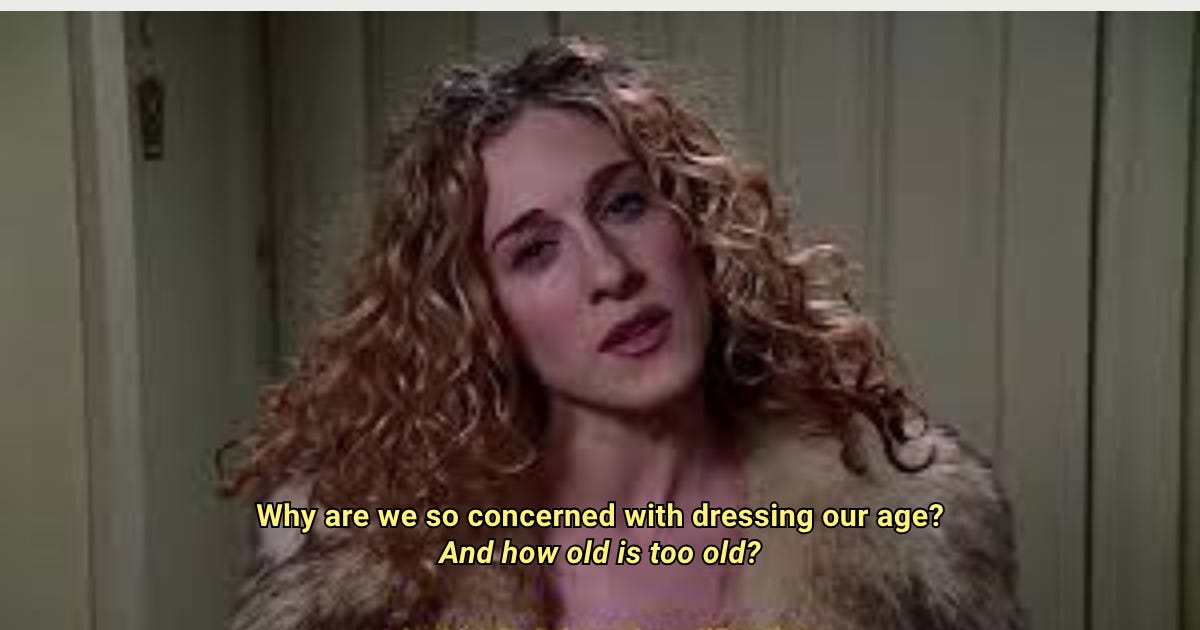
How old is too old?
I knew Marta wasn’t the root of this thinking. She was, like me and so many other women, reacting to a culture of obsession with age, and the power that comes with looking young.
Welcome to the age of anti-aging.
Where girls are policed for their skirts being too short. Women are shamed for not dressing provocatively enough. Then, at some arbitrary age that must be written in a rule book I haven’t read, women are too old to wear just about anything.
Translation:
Young women shouldn’t dress “older” than their age, and older women shouldn’t dress “younger.”
Only those in the magical, made-up-middle may dress the way they want.
And even then, we’re sure to get feedback.
Since entering my late 30s, people have a lot to say about my age.
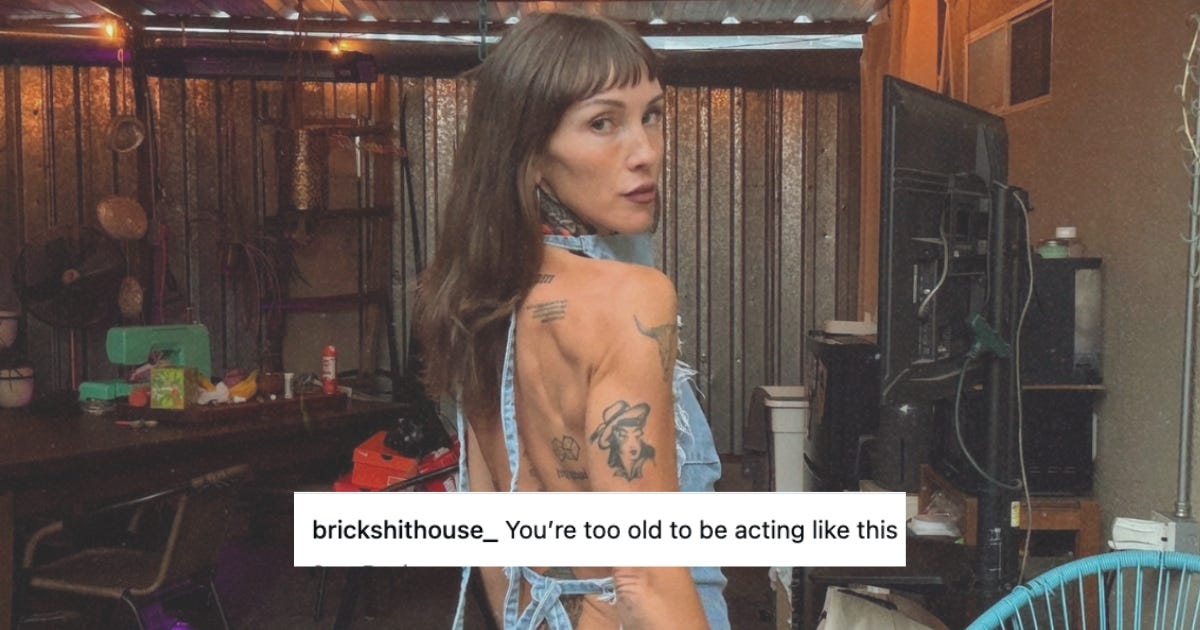
Comments on my instagram range from “you’re too old to be wearing that” to “you look like a hooker.”
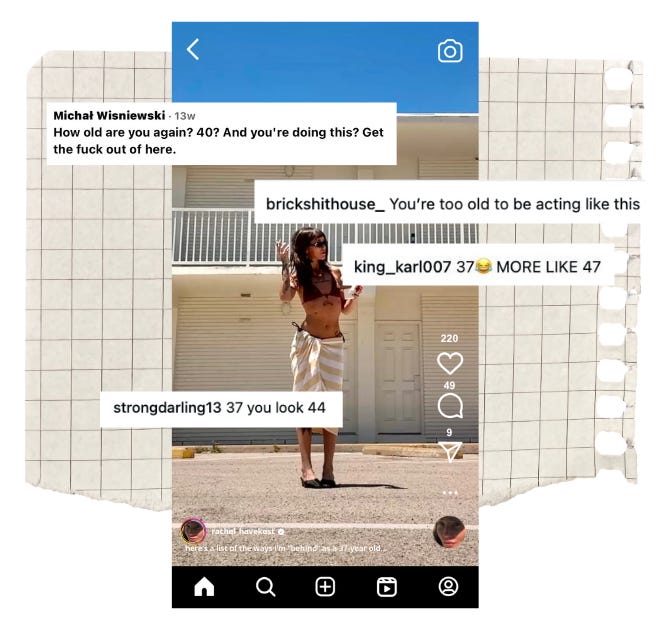
The underlying message is this: being young is better.
And if you can’t be young, you better look young if you want to act (and dress) the way you want.
spoiler alert: I will not stop dressing how I want. In fact as a 37-year old who apparently looks 44, I am still getting partnerships with clothing companies like BNTO, a woman-run company that lets you rent designer clothes and only keep what you want. They’re not paying me to say this, but they did send me a box of killer pieces that king_karl007 is gonna have to peel off my dead body one day.
Since I have no plans to stop wearing what I want, I anticipate the age-shaming will only get worse the older I get.
Which got me wondering in my most Carrie-coded, BNTO dressed way: how in the absolute fuckery did we get here?
“Youth obsession” isn’t new. In fact dare I say, it’s old.
I had to.
From a biological standpoint, youthfulness signals prosperity: higher chances of fertility, peak physical health for labor, sharper mental faculties for survival, etc.
Sure, we aren’t fending off tigers or foraging for berries to stay alive anymore. But staying young, whether we are consciously aware or not, is still about survival.
We’re fighting systems, climbing social ladders, networking online until our eyes bleed and drowning in a digital sea of potential lovers, friends, and financial security.

Chronically online-ism has made us perpetually self-aware (and not in a psychological way).
Since COVID, more people have sought cosmetic surgery to alleviate self-consciousness associated with seeing their reflection in Zoom calls.
Facial plastic surgeon Dr. Amanda Goslawski says, “patients tell me they see themselves on a work call and think, why do I look so old?”
As if needing to look younger wasn’t good enough, we’re now seeing a rise in “prejuvination”: procedures that are meant to, I don’t know, stop time?
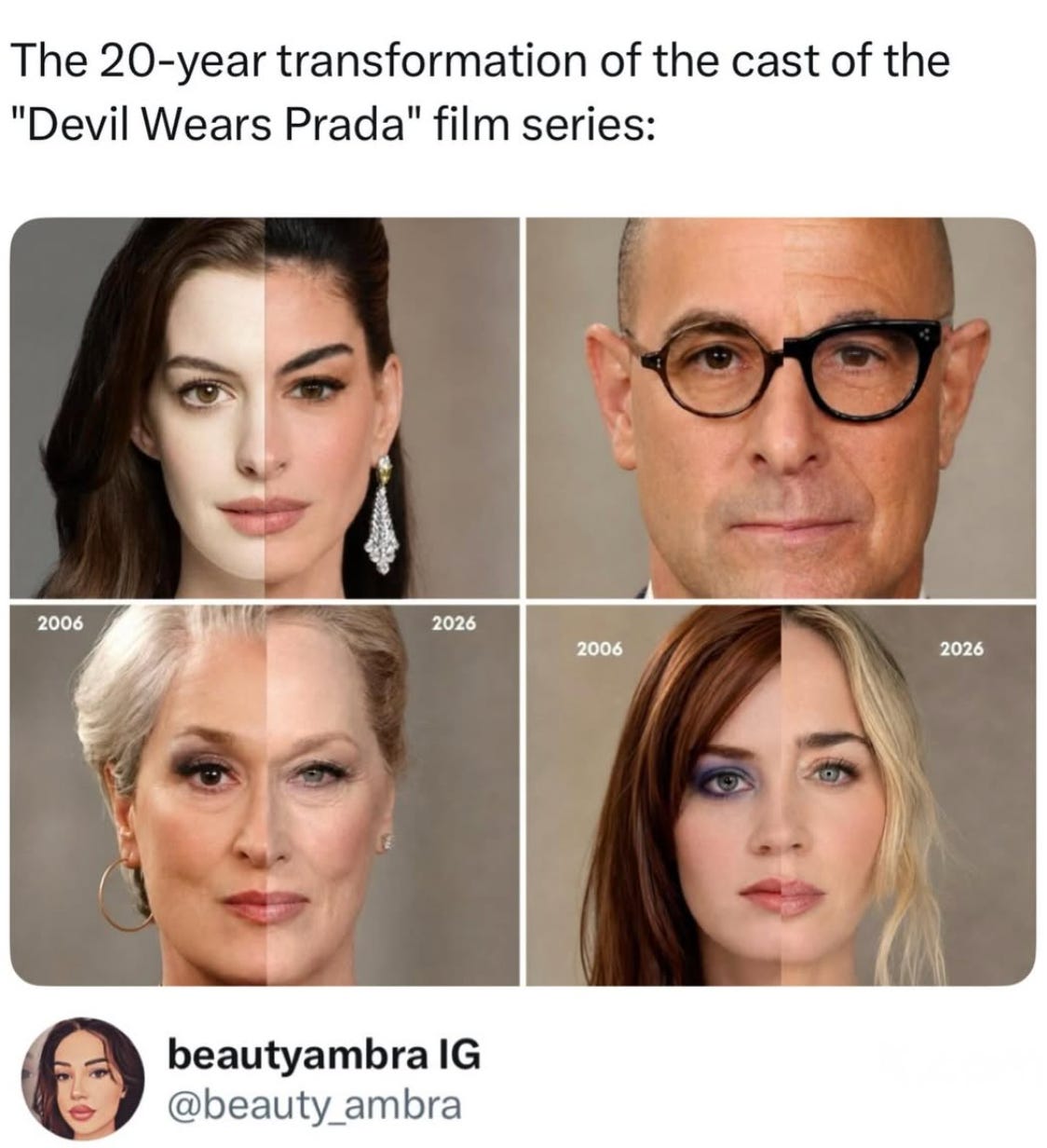
But wait, there’s more! Why stop time when you could reverse it?
Celebrities are “aging backwards” and using peptides to “reverse” aging, and consumers are eating that shit up.
Social media, unsurprisingly, has not just glamorized aging backwards, it’s normalized it.
Anti-aging trends and reverse aging content is rampant on Gen Z feeds. Botox to prevent wrinkles. Facelifts before the age of 30. Peptides for losing weight and looking 10 years younger.
Nothing like a viral “before and after my laser treatment” from an influencer to take self-care from journaling at home to spending thousands of dollars at a clinic.
And no—I’m not immune to this impact.
I’ve spent thousands of dollars on botox and fillers, beauty products, my hair, my nails—you name it. I drank the Kool-Aid, and I’m still trying to recover from its poisonous effects.
After the release of the Epstein files, I had to take a hard look at how deeply that poison ran through me, and who offered me the Kool-Aid in the first place.
Mall culture of the early aughts was owned by men associated with Epstein. Stores that sold primarily to young women and children. Epstein was a driving force behind the obsession with prepubescence and the sexualization of young children.
-Ileana Justine
In a world where big name brands run by big bad men informed beauty standards, women learned from an early age that their status was intrinsically connected to their appearance. And not just a pretty one—a youthful one.
Women, whether they knew it or not, were dressing not just for the male gaze, but the pedophilic gaze: one whose orientation perversely strayed from “looking young” to “looking like a child.”

Naturally, capitalism said “let’s monetize!”
Leave it to the men in charge to turn humans into a product.
The $698 billion beauty industry rakes in roughly $46 billion per year on cosmetic procedures alone. Beauty companies spend upwards of $300 million on advertising, with consumers spending up to $10,000 on beauty products per year.
If you’re a data-junkie like me, here’s some wild stats to chew on:
Women made up 86.5% of people getting cosmetic procedures between 2018-2024, while only 13.5% of men did.
According to data from 2020, 82% of people receiving Botox were white, while under 7% were Black, Asian, Pacific Islander, and Hispanic.'
Similarly, other “youth-enhancing” procedures like filler and chemical peels were performed almost 10x more on white people (78%) than people of color (<10%).
Data is sparse for trans and non-binary folks. This is sadly unsurprising, and we desperately need more inclusive research. Since the data that does exist tends to clump gender-affirming care and aesthetic procedures into the same category (which they aren’t), it’s difficult to know what percentage of people getting “youth-enhancing” procedures are trans or non-binary.
Turns out, looking young has its perks.
Romance. Career. Self-worth. Youth is desired, rewarded, and prescribed.
In a 2025 study of 4,500 blind dates, both men and women preferred to date younger. Theoretically, by looking younger someone’s dating pool expands simply by passing for a demographic that has more singles.
A 15-year-long study of almost 50,000 MBA students called “When Does Beauty Pay,” found that “attractive” people were 52.4% more likely to have well-paying jobs after graduating college.
It’s a stark reminder that success is influenced not just by skills and qualifications, but also by societal perceptions of beauty. -Kannan Srinivasan, CMU
The rich stay young, the young get rich, and the rich get richer.
“Youthfulness,” at least from an aesthetic standpoint, is a privilege.
Procedure costs that keep people looking young range from $100 to $500k, and most require maintenance or repeat visits.
These procedures are not something a person with an average salary can afford without racking up some Manolo Blahnik Carrie-credit-card debt.
Women of color (whose salary is on average half that of a white woman in the U.S.) are less likely to be able to afford these procedures. We’ve seen the data—people of color aren’t getting even close to as many cosmetic procedures as white women.*
From pedophilic predators shaping beauty standards to cosmetic procedures signaling status, looking young is now linked to power: youthfulness has become a cog in a classist, sexist, racist system, and we can’t ignore it.
*Obviously what I’ve deduced is based on statistics, which doesn’t account for cultural differences in how people view the aging process. If you have more insights, I’m all ears.
I know that Marta and I are not the problem, we are the product.
As someone deeply in love with fashion and putting together an outfit, I am altogether in a midlife Carrie-crisis trying to parse out which part of my style is rooted in Rachel, and what’s rooted in the big bad system.
“In the same way that little girls are taught early on to embody the characteristics of ‘femininity,’ such as docility and caregiving, they are also trained—often subconsciously—on how to aesthetically present themselves within the context of being consumed.”
I’m working really hard on embracing aging and cleansing myself of the notion that “younger” is more attractive.
I’m not great at it (yet). I’ve been getting botox since I was 26, and the older I get, the more obsessed I become with “looking young.” I’m a work in progress—but not in the aesthetic ways I’ve been attached to for so long. It’s a new shift, and I imagine it will take time.
As for the comments I get about being old—they don’t hurt my feelings or send me running to my injector. They’re a different kind of jab. A tiny incision where I actually need work done: on the part of me that knows aging is the real privilege, and if I’m getting older, it means I’m staying alive.
In an effort to bolster this belief and collect mantras or wisdom or glimmers or what-have-you for when I find myself slithering down the anti-aging drainpipe, I posted a reel asking my instagram audience to share what they’d tell someone in their 20s about getting older.
The responses echoed one overarching sentiment:
Be yourself, let go of external validation, and wear whatever the hell you want.
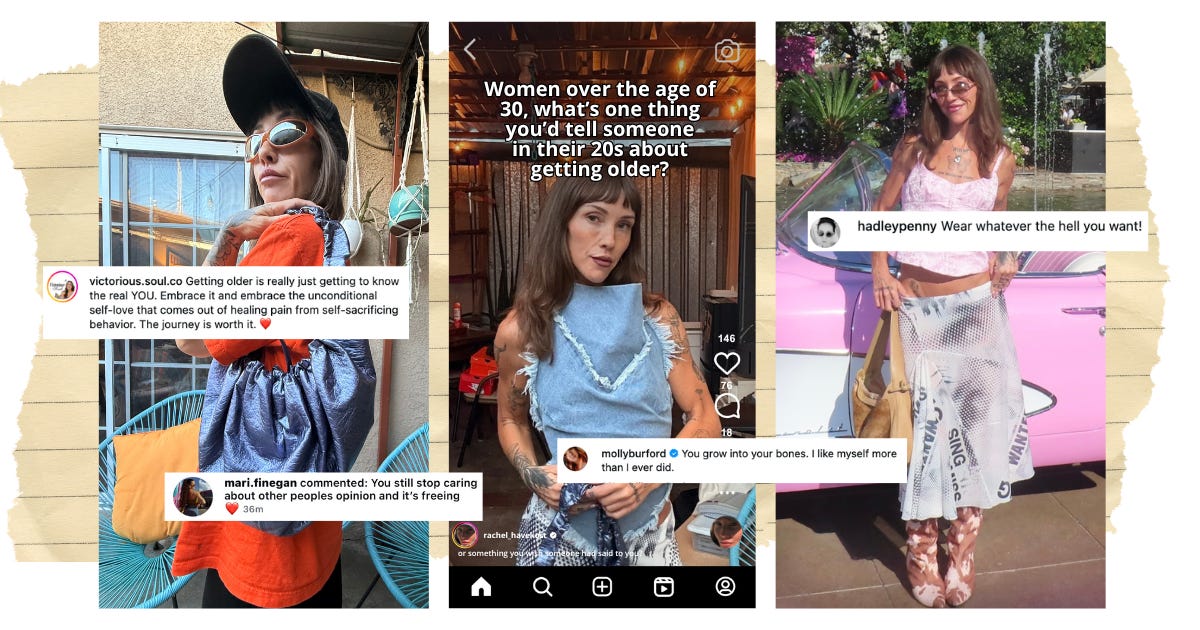
I’m glad that before I left Marta’s shop, sticky skin still clinging to my sweater, I was able to hold on to these reminders.
On my way out, I thanked her and asked her name. We awkwardly shook hands. I wanted to hug her, but that would have been a sweaty hug for Marta.
Sheepishly, but with as much confidence as I could conjure, I affirmed what I believed to be true:
“I’ll be back—because I hope to dress like this until I’m 50, and for a whole lot longer.”
XX RACH
❤︎ before you go!!!
References:
https://www.bbc.com/worklife/article/20210503-how-looking-young-can-shape-your-career
https://www.theglobeandmail.com/life/social-trends/article-gen-z-skincare-social-media/
https://www.plasticsurgery.org/documents/News/Statistics/2020/cosmetic-procedures-ethnicity-2020.pdf
This, yes! I’m also 37 and feel like I’m somehow suddenly too old to wear or do certain things, yet just a few years ago I was too young to be taken seriously? Fuck all that 😂 Appreciate you shining light on the importance of looking at intersectionality within these convos too. Your wise words and being a total baddie constantly inspire me! 💓
Holy SHIT you are an amazing writer - love love love this! Found and followed you for your outstandingly open social media posts (as I am working on finding comfort in my own vulnerability), staying for the passion and absolute magic in your work ✨